
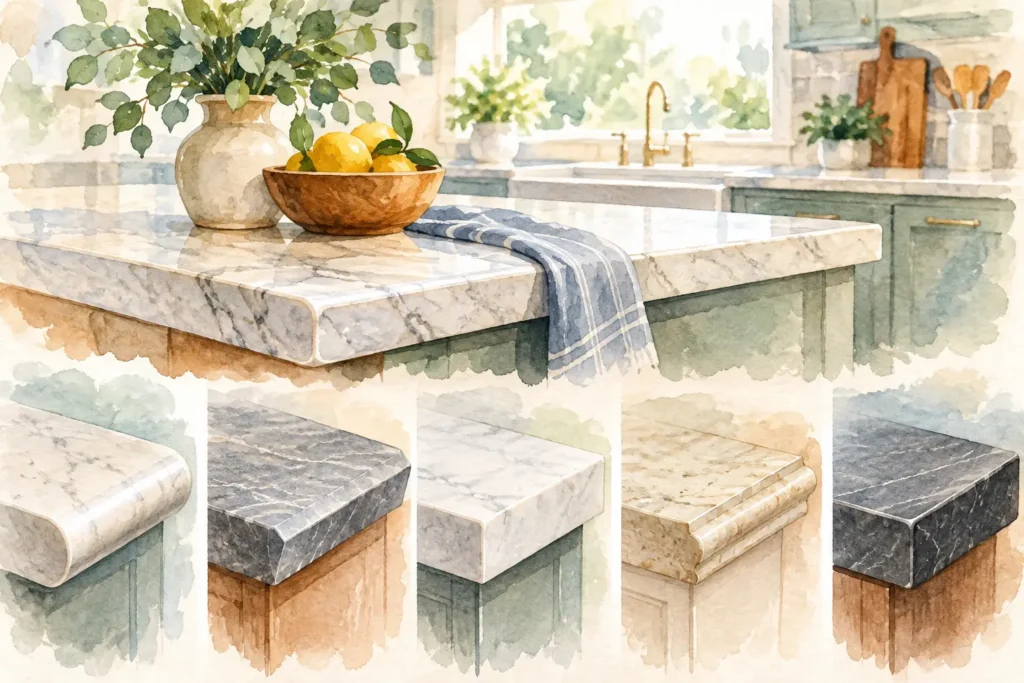
A countertop edge may look like a small decision beside cabinet color and slab selection, but it changes the way a kitchen feels every day. The top kitchen countertop edge profiles can make a clean-lined quartz island look tailored, soften a busy family kitchen, or give natural stone the depth and presence it deserves. They also affect comfort at the sink, how easily the surface cleans, and the fabrication work required to achieve the finished look.
At Marble Unlimited, we encourage homeowners to consider the edge while selecting their slab, not after the material is already chosen. The best option is not simply the most decorative profile. It is the one that suits your kitchen’s style, your countertop material, the thickness of the slab, and the way your household uses the space.
How to Choose Among Top Kitchen Countertop Edge Profiles
Start with the architecture already in the room. A contemporary kitchen with flat-panel cabinetry often benefits from a crisp eased or beveled edge. Traditional cabinetry, detailed range hoods, and furniture-style islands can carry a more sculpted ogee or bullnose profile beautifully. The edge should support the design rather than compete with the stone’s movement, veining, or color variation.
Daily use matters just as much. Homes with young children often favor softened edges, particularly on an island with seating. A square, sharply defined edge creates a strong modern statement, but a lightly eased corner is generally more forgiving while keeping that tailored appearance. If you cook often, consider cleanup around the sink and perimeter counters. Simpler profiles leave fewer contours where crumbs and spills can collect.
Material is another deciding factor. Granite and quartzite often perform well with a wide range of profiles because of their natural strength. Quartz provides consistent results for clean, contemporary edges and many decorative shapes. Marble can be shaped with beautiful detail, though its softer composition deserves thoughtful use in high-contact areas. The right profile should respect both the look and the practical character of the selected material.
Eased edge: clean, versatile, and easy to live with
An eased edge is one of the most requested choices for good reason. It begins with a straight edge and a slight softening at the top and bottom corners. From a few feet away, it reads as crisp and modern. Up close, it feels more comfortable than a truly sharp square edge.
This profile works with nearly every cabinet style and is especially effective when the slab itself is the visual focus. A dramatic quartzite, richly patterned granite, or marble with prominent veining does not need a heavily ornamented edge to make an impression. Eased edges are also easy to clean and generally offer a straightforward fabrication option.
Pencil edge: a refined variation on a simple line
A pencil edge has a more visible rounding than an eased edge, creating a soft, narrow curve along the top. It remains understated but adds a finished, gentle touch. It is a strong choice for homeowners who want an uncluttered kitchen without the hard geometry of a square profile.
Pencil edges work particularly well on perimeter countertops, where their subtle shape complements a variety of sinks and backsplashes. They are practical, comfortable to lean against, and well suited to transitional kitchens that mix classic and current elements.
Beveled edge: definition without heavy ornament
A beveled edge uses a flat angled cut, usually along the top edge of the countertop. That angled plane catches the light differently than the face of the slab, adding shadow lines and definition. It is a polished choice for homeowners who want more dimension than an eased edge without moving into a traditional decorative profile.
The bevel can be narrow and restrained or more pronounced, depending on the design. A subtle bevel often complements Shaker-style cabinetry, while a larger bevel can give a thick island a more formal appearance. Because the edge has a crisp change in plane, it looks best when fabrication lines are precise and the countertop installation is carefully aligned.
Bullnose edge: soft, family-friendly, and timeless
A full bullnose rounds the countertop edge into a smooth semicircle. A half bullnose creates a rounded top with a flatter underside. Both remove sharp corners and bring a softer visual weight to the room.
Bullnose profiles are often chosen for active family kitchens, rounded architectural details, and traditional homes. They are also comfortable along breakfast bars and island seating. The trade-off is visual: a full bullnose can make a sleek, modern kitchen feel more traditional, and the rounded lower edge may slightly obscure the slab’s thickness. A half bullnose often offers a useful middle ground.
Ogee edge: classic detail for formal kitchens
An ogee profile combines a concave curve with a convex curve, creating a graceful S-shaped detail. It has long been associated with traditional and luxury kitchen design, especially where cabinetry includes raised panels, crown molding, or other layered millwork.
This edge can be striking on a center island or a dedicated baking area, particularly in marble or granite with a refined pattern. It is not automatically the right choice for every surface. An ogee adds visual activity, so pairing it with an extremely busy slab or highly decorative cabinetry can make the room feel crowded. It also takes more fabrication time and requires a little more attention during cleaning than a simple eased edge.
Mitered edge: the look of a thicker slab
A mitered edge joins two pieces of material at an angled seam to create the appearance of a much thicker countertop. It is commonly used for substantial waterfall islands, bold contemporary designs, and kitchens where the countertop is meant to read as a sculptural architectural element.
The appeal is immediate: a 2-centimeter slab can appear dramatically thicker without requiring a solid block of stone. Mitering is a precision fabrication process, and successful results depend on accurate cuts, close seam alignment, and a skilled installation team. This option also adds cost compared with a standard eased edge, but it can be the detail that gives an island its custom presence.
Laminated edge: added thickness with design flexibility
A laminated edge uses a second piece of the same material bonded beneath the countertop edge. Unlike a mitered edge, the seam is typically visible on close inspection, though a well-matched slab and experienced fabrication make it far less noticeable. It creates a thicker profile and can be shaped into an eased, beveled, or decorative design.
This approach is useful when you want a substantial countertop face but prefer not to miter the entire perimeter. It can also help create a stronger visual connection between a large island and weighty cabinetry. During a showroom consultation, ask to see examples of laminated and mitered edges side by side. The visual difference is easier to judge in person than from a small sample.
Matching the Edge to Your Kitchen’s Priorities
For a kitchen that needs to stay current through changing paint colors and hardware, simple profiles are usually the safest investment. Eased, pencil, and modest bevel edges have broad design appeal and allow the slab to remain the focal point. They also tend to work well if you expect the kitchen to appeal to future buyers.
For a highly personal renovation, a distinctive edge can be exactly right. An ogee profile may echo the detailing of a historic home. A mitered island can bring the drama needed in an open-concept space with tall ceilings. The question is not whether the edge is trendy. It is whether it belongs with the rest of the home and will still feel intentional years from now.
Thickness should be discussed at the same time. Many countertops are fabricated from 2-centimeter or 3-centimeter material, and the available edge treatments can vary. A profile that feels proportionate on a thinner perimeter counter may need a larger scale on a broad island. Overhangs, support requirements, seating areas, and the location of cooktops or sinks can also influence the final recommendation.
Details to Discuss Before Fabrication
Before approving the final design, confirm which edges will be used on each countertop. Perimeter counters and islands do not have to share the same profile. A kitchen may use a simple eased edge around the room and reserve a mitered or ogee edge for the island. This creates a focal point without adding detail everywhere.
Ask how the profile will meet your sink cutout, cooktop, and corners. Inside corners, exposed ends, and waterfall panels need the same level of planning as the front edge. If your slab has dramatic veining, the fabrication layout should also consider how that movement carries across a mitered edge or laminated build-up.
A full slab viewing is the best time to make these decisions. Seeing the material at scale helps you understand whether a detailed profile will enhance its character or distract from it. It also gives your fabricator the information needed to plan seams, edge direction, and the most attractive areas of the stone for visible surfaces.
The right edge is one you notice quietly for all the right reasons: it feels good under your hand, fits the room’s style, and lets the craftsmanship of the countertop stand out. Schedule a showroom visit with Marble Unlimited to compare edge samples against your chosen slab and make the final detail feel as considered as the rest of your kitchen.