
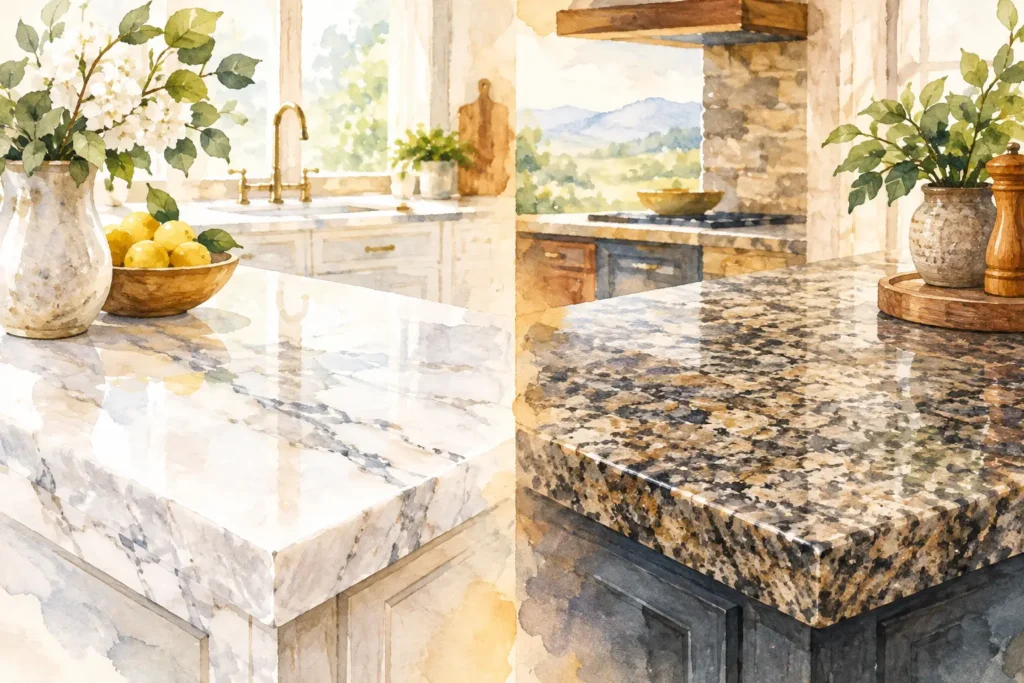
The marble vs granite decision is rarely settled by a sample alone. Both are natural stone, both can make a kitchen or bathroom feel more substantial, and both offer individual character that manufactured patterns cannot duplicate. Yet they live very differently in a busy home. The right choice comes down to how you use the space, how you want it to look years from now, and how comfortable you are with routine care.
For homeowners planning a renovation, the best first step is to view full slabs in person. A small sample cannot show the movement, veining, mineral variation, or overall tone that will define a large island, vanity, fireplace surround, or outdoor entertaining area.
Marble vs Granite: The Essential Difference
Marble and granite are both natural stones, but their composition creates very different looks and performance characteristics. Marble is formed from limestone exposed to heat and pressure. It is known for its flowing veins, soft background colors, and classic appearance. Some slabs are quiet and understated; others have dramatic movement that becomes the focal point of a room.
Granite forms from cooled magma and is generally harder and denser. Its visual pattern often includes crystals, specks, waves, and sweeping mineral movement. Granite can range from nearly uniform dark tones to bold, high-variation slabs with white, gold, gray, blue, green, or warm brown details.
Neither material is objectively better. Marble tends to appeal to homeowners who want a refined, timeless surface and are comfortable with signs of use. Granite is often the practical favorite for households that want natural stone with greater day-to-day resistance to scratches, heat, and stains.
Choose Marble for Character That Develops Over Time
Marble has been used in architecture and interiors for centuries because it brings a sense of depth that is difficult to imitate. Its veining is not a printed pattern. It runs through the stone, which gives each slab a distinctive, dimensional quality. In a light-filled kitchen, a marble island can soften painted cabinetry and create an elegant centerpiece. In a bathroom, it can make a vanity or shower surround feel tailored and calm.
The trade-off is that marble is more reactive than granite. Acidic foods and drinks, including citrus, vinegar, wine, and tomato-based ingredients, can dull the polished finish. This is called etching. Etching is different from a stain: it changes the surface sheen rather than leaving color behind. Marble can also scratch more easily than granite, particularly in hardworking kitchen zones.
That does not mean marble is unsuitable for kitchens. Many homeowners choose it precisely because they appreciate its lived-in character. A honed finish, which has a softer matte appearance, can make minor etching less noticeable than a high-polish finish. Marble also works beautifully for bathroom vanities, fireplace surrounds, decorative wall applications, and areas where its movement can be appreciated without constant food preparation.
If you select marble for a kitchen, use cutting boards, wipe up acidic spills promptly, and expect a natural patina over time. For some families, that evolving finish feels authentic and welcoming. For others, it becomes a source of unnecessary worry. Being honest about that preference matters more than following a trend.
When Marble Makes the Most Sense
Marble is an excellent fit when design is the primary driver and the space will receive moderate use. It is especially well suited to a statement island, a guest bath, a powder room, a fireplace, or a vanity where you want graceful veining to lead the design. It can also be a thoughtful choice for an avid baker, since its naturally cool surface is pleasant for working with pastry dough.
Choose Granite for Everyday Strength
Granite is one of the most durable natural-stone choices for active kitchens. It generally resists scratching better than marble and handles normal cooking heat well, though trivets remain a smart habit to protect both the stone and its finish. With proper sealing, granite also offers strong resistance to everyday staining.
This resilience makes granite a sensible option for family kitchens, rental properties, outdoor kitchen counters, laundry rooms, and frequently used bathroom vanities. It is well equipped to handle the regular rhythm of setting down groceries, preparing meals, hosting friends, and cleaning up afterward.
Granite is not maintenance-free, and it is not indestructible. Natural stone should be cleaned with a pH-neutral stone cleaner or mild soap and water rather than harsh chemicals. A quality sealer helps limit absorption, but sealing needs vary by slab. Some dense granites may need little attention for long periods, while more porous materials may benefit from more frequent resealing.
Visually, granite offers much more variety than many homeowners expect. A quiet slab can complement clean, contemporary cabinetry, while a highly active granite can bring warmth and energy to a larger kitchen. The key is pairing the slab with the rest of the room. If the cabinetry, flooring, and wall finishes already have strong pattern, a calmer granite often creates better balance. If the room is otherwise simple, a more expressive slab can become the feature.
When Granite Makes the Most Sense
Granite is a strong choice when durability, easy daily living, and natural variation are high priorities. It works particularly well for busy kitchens, homes with young children, and projects where homeowners want a natural stone surface without needing to monitor every spill. It is also worth considering for exterior projects, provided the specific stone and installation details are selected for local weather conditions.
Compare Maintenance Before You Compare Color
Homeowners often begin by asking which stone is easier to maintain. Granite usually has the advantage, but the better question is whether the maintenance level matches your habits. Both materials benefit from professional fabrication, careful installation, and sealing appropriate to the stone.
For daily care, wipe countertops with a soft cloth and mild cleaner. Avoid abrasive pads and products containing strong acids or bleach. Use cutting boards rather than cutting directly on either surface, and clean up oils, wine, juice, and sauces without letting them sit.
Marble requires more awareness because it can etch and absorb spills more readily. Granite is more forgiving, but it still needs sensible care and occasional resealing. A professional fabricator can assess the slab you select and explain the appropriate sealing and cleaning approach before installation.
Finish also affects maintenance and appearance. Polished stone reflects light and emphasizes color depth, but it can show etching more clearly on marble. Honed stone has a softer look and can better disguise minor surface changes, although it may show fingerprints or darken temporarily from moisture depending on the material. Seeing both finishes alongside your cabinet samples is often more useful than reading about them.
Cost Depends on More Than the Stone Name
It is tempting to assume marble always costs more than granite, but natural-stone pricing is not that simple. Availability, slab rarity, thickness, color, movement, fabrication complexity, edge profile, cutouts, and installation requirements all affect the final investment. A common granite may cost less than an imported, highly veined marble, while an exotic granite can cost considerably more than a simple marble selection.
The size and shape of your project matter as well. A large island, multiple seams, waterfall panels, full-height backsplashes, and detailed fireplace work require more material planning and skilled fabrication. Choosing a slab only by price per square foot can lead to surprises later. A complete quote should account for the finished project, not just the raw slab.
At Marble Unlimited, viewing slabs in the Hillsborough showroom allows homeowners to compare colors, movement, finishes, and price ranges before committing to a direction. Bringing cabinet door samples, paint colors, flooring samples, and a few photos of the room makes that conversation much more productive.
Make the Decision With Your Real Life in Mind
If you love the graceful movement of marble and can accept a surface that gains character with use, marble may be the material that makes your project feel personal. If you want a hard-working natural stone that offers more day-to-day forgiveness, granite is likely the better match. In some homes, the answer is not one or the other: granite may serve the main kitchen while marble adds elegance to a vanity, fireplace, or smaller focal area.
The most satisfying stone projects begin with the full picture: how the room is used, what surfaces surround it, how much maintenance feels reasonable, and which slab you will still enjoy seeing every morning. Schedule a showroom visit with your measurements and design samples, then let the material itself help make the choice clear.