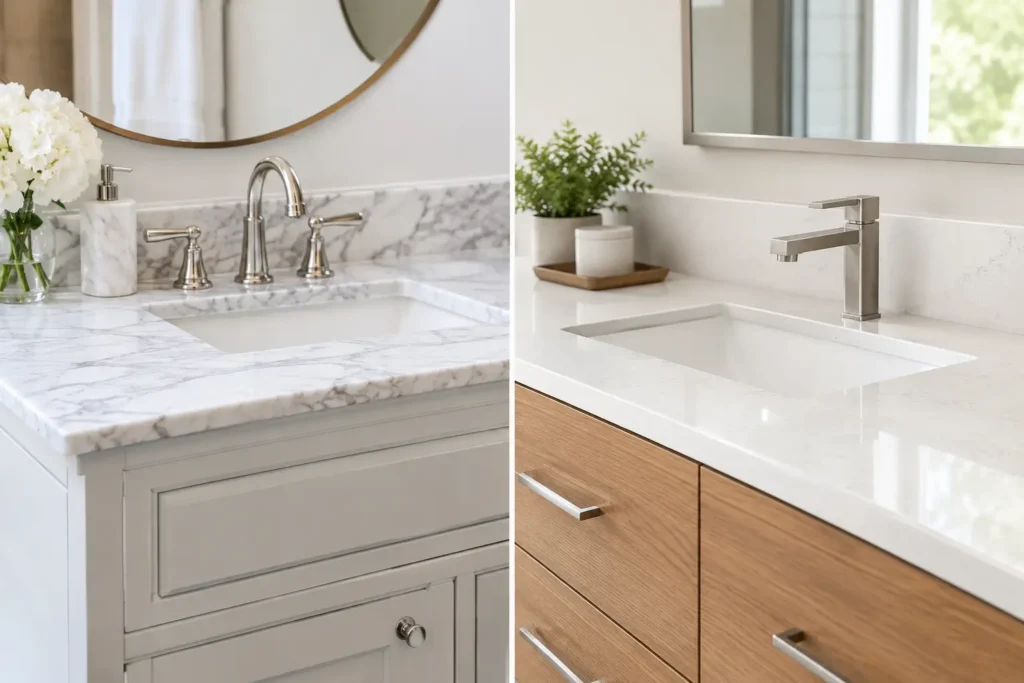
A bathroom vanity has to do more than look beautiful under good lighting. It has to handle toothpaste, cosmetics, hand soap, damp towels, and the occasional rushed morning. When homeowners compare marble versus quartz vanities, the right answer usually comes down to one question: do you want the one-of-a-kind character of natural stone, or the consistency and easier routine of an engineered surface?
Both materials can create a polished, high-end bathroom. Both can be fabricated for a custom sink opening, edge profile, backsplash, and cabinet layout. Their differences become clearer once you consider how your household uses the room and what level of variation and maintenance feels right for your renovation.
Marble Versus Quartz Vanities at a Glance
Marble is a natural stone cut from a slab, so every vanity has its own veining, movement, and color variation. Quartz is an engineered material made with natural quartz minerals and resins, offering a more controlled appearance and a nonporous surface.
For a primary bath designed around natural materials, dramatic veining, or a classic architectural look, marble can be exceptional. For busy family bathrooms, rental properties, or homeowners who want a low-maintenance surface with reliable color consistency, quartz is often the more practical choice.
Neither option is automatically better. A beautifully fabricated marble vanity that is selected with realistic expectations can bring lasting character to a home. A well-chosen quartz vanity can provide a clean, tailored look while making everyday cleanup much simpler.
Why Homeowners Choose Marble
Marble has a visual depth that is difficult to duplicate. Its veining is formed by nature, not repeated by a manufacturing process, so a full slab can make a vanity feel like a focal point rather than simply another horizontal surface. White marble with soft gray movement remains a favorite for traditional, transitional, and European-inspired bathrooms, while warmer and darker marbles can suit more tailored or dramatic spaces.
It also works especially well when a bathroom design includes other natural finishes, such as painted wood cabinetry, warm metals, or architectural stone details. A fabricator can help position the most compelling section of the slab across the vanity, around a sink, or along a matching backsplash. That slab layout is a major part of the finished result.
The trade-off is that marble is softer and more absorbent than quartz. It can etch when acidic products come into contact with it. Etching is a change in the surface finish, often appearing as a dull or lighter mark, rather than a traditional stain. Common bathroom products, including some cleansers, hair products, and cosmetics, can cause it.
Sealing helps marble resist absorption, but it does not make the stone maintenance-free or prevent etching. A homeowner who chooses marble should be comfortable wiping spills promptly, using stone-safe cleaners, and appreciating that a natural surface may develop a gentle patina over time. For many clients, that lived-in quality is part of marble’s appeal. For others, it becomes an ongoing frustration.
Marble is often the right fit when
Marble is worth serious consideration for a lightly used powder room, a carefully maintained primary bathroom, or a design where the slab itself is central to the room. It is also a strong choice for homeowners who value natural variation and do not expect a perfectly uniform surface years later.
A honed finish can be a thoughtful option for many bathroom projects. Because it has a softer, matte appearance, it may make minor etching less visually obvious than a highly polished finish. The best finish still depends on the particular slab, lighting, cabinetry, and overall design direction.
Why Quartz Works So Well in Bathrooms
Quartz has earned its reputation as a dependable vanity material for good reason. Its nonporous composition resists moisture and does not require routine sealing. In a bathroom shared by children, guests, or multiple family members, that easier care can be meaningful.
Most everyday messes can be cleaned with mild soap, water, and a soft cloth. Quartz also offers excellent color consistency, which can make planning easier when you need two matching vanities, a long double-sink top, or additional pieces for a larger renovation. Many styles provide soft movement, subtle veining, or a clean solid look without the unpredictability of a natural slab.
Quartz is not indestructible, however. It should not be treated as a surface that can withstand every cleaner or every condition. Abrasive pads and harsh chemicals can affect its finish, and excessive direct heat can be harmful. In a vanity application, heat is usually less of a concern than it is in a kitchen, but proper day-to-day care still matters.
The other consideration is visual preference. High-quality quartz can look refined and elegant, but it will not have the exact mineral depth or spontaneous veining of genuine marble. Some homeowners prefer its controlled look. Others see natural variation as essential to the character of their home.
Quartz is often the right fit when
Quartz is especially well suited to busy bathrooms, households that prefer minimal upkeep, and projects that call for a consistent look from room to room. It is also a practical option when a homeowner wants a bright, marble-inspired appearance but would rather avoid the likelihood of etching and the responsibility of periodic sealing.
For multi-bath renovations, quartz can simplify coordination. The same selection can be carried through a primary bath, hall bath, and guest bath while maintaining a cohesive color palette around cabinetry, wall color, mirrors, and fixtures.
Cost Depends on More Than the Material
Comparing only the per-square-foot price can lead to surprises. Vanity pricing is influenced by the slab selected, thickness, edge detail, sink cutout, number of faucet holes, backsplash design, support requirements, and installation conditions. A compact powder-room vanity may use relatively little material, yet still requires careful measuring, fabrication, finishing, and installation.
Some marble selections are priced competitively, while rare or heavily veined slabs can command a premium. Quartz pricing also ranges widely based on color, pattern, brand, thickness, and availability. The best value is not always the least expensive slab. It is the material that fits the design, performs appropriately for the room, and is fabricated correctly the first time.
A showroom visit is useful because color samples alone rarely tell the full story. Natural marble should be viewed as a full slab whenever possible, especially when veining is a priority. Quartz should also be seen in person so you can evaluate its pattern scale, finish, and undertones against your cabinet and fixture selections.
Details That Affect the Finished Vanity
Material choice is only one part of a successful bathroom surface. An experienced fabricator will also help you consider sink style, edge profile, backsplash height, wall conditions, and where seams can be minimized or made less noticeable. A simple eased edge may support a clean contemporary cabinet, while a more detailed edge can reinforce a traditional design.
The sink also changes the way the surface performs and looks. An undermount sink creates a streamlined transition and makes countertop cleanup straightforward. A vessel sink places more visual attention on the top itself and calls for careful planning around faucet placement and finished height.
For marble, slab layout deserves particular attention. Veins can be directed to flow across a double vanity, centered behind a sink, or placed to create a quieter working area. For quartz, the goal may be matching pattern direction across a backsplash and countertop or choosing a design with enough movement to feel natural at full scale.
Make the Choice Based on Your Real Routine
Choose marble if its natural beauty is the reason you love the design and you are willing to care for it accordingly. Choose quartz if you want an elegant, dependable vanity surface that asks less of your daily routine. There is no need to choose marble simply because it feels luxurious, and no need to dismiss it if you understand how it will age.
For homeowners in the Chapel Hill, Durham, and Raleigh area, seeing full slabs and larger samples side by side can make the decision far easier than comparing images online. Marble Unlimited can help you evaluate the look, maintenance needs, fabrication details, and installation plan before you commit. Bring cabinet samples, fixture finishes, and a few photos of the room – the right vanity surface should feel considered from the first selection through the final installation.