
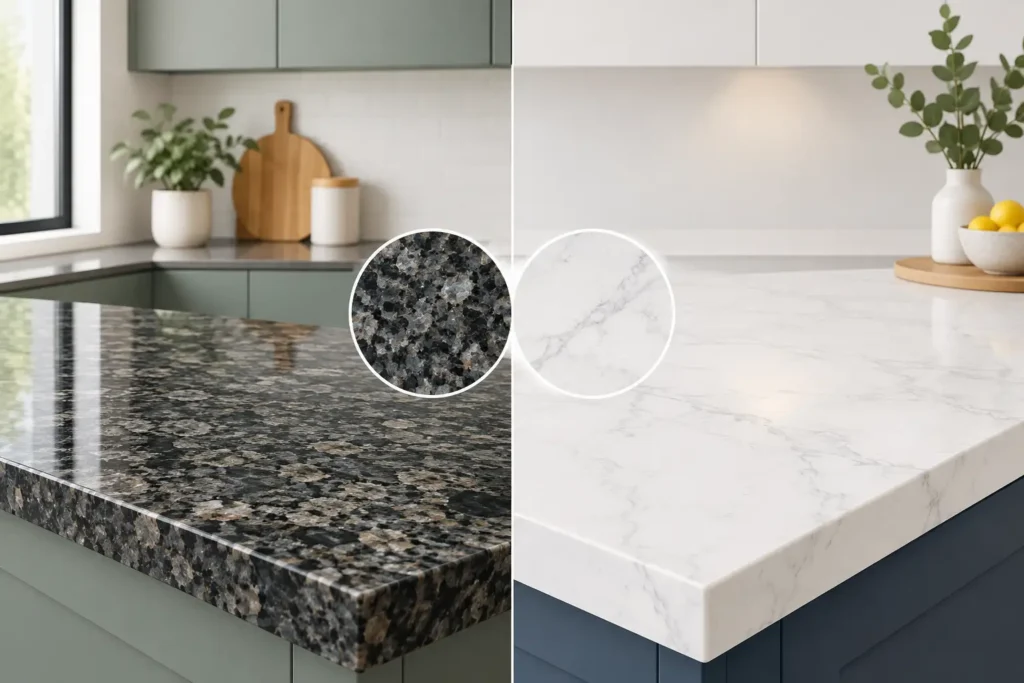
A countertop has to work harder than almost any surface in your home. It handles hot pans, hurried breakfasts, spilled wine, homework, and the daily visual weight of your kitchen. When homeowners compare granite vs quartz countertops, the right answer is rarely about which material is universally better. It is about how you cook, how you want the room to look, and how much natural variation you want to welcome into the design.
Both are beautiful, durable choices for kitchens and bathrooms. The meaningful differences come down to composition, maintenance, heat resistance, visual character, and the way each slab fits your overall renovation plan.
Granite vs Quartz Countertops: The Core Difference
Granite is a natural stone formed within the earth over millions of years. Every slab has its own mineral pattern, movement, veining, and color variation. Some granite is subtle and consistent, while other selections make a strong statement with dramatic swirls and crystalline detail. No two installations are exactly alike.
Quartz countertops are engineered surfaces made from crushed natural quartz combined with pigments and binding resins. That manufacturing process gives quartz a more controlled appearance. It can offer soft, uniform colors, bold contemporary patterns, or marble-inspired movement with a level of consistency that natural stone cannot always provide.
This difference matters most when you are selecting cabinets, a backsplash, hardware, and paint. Granite asks you to embrace the personality of a specific slab. Quartz gives you greater predictability across a larger kitchen, especially when several slabs are needed.
Appearance: Natural Character or Design Consistency?
For homeowners who want a one-of-a-kind kitchen, granite has lasting appeal. Its depth comes from natural minerals rather than a printed pattern. Under changing light, you may see flecks, crystals, and movement that make the surface feel alive. A carefully selected granite can become the focal point of a kitchen without feeling overly formal.
Quartz is often the stronger choice when the goal is a tailored, coordinated look. It works especially well in kitchens with clean-lined cabinetry, large islands, or a quiet color palette. Many quartz designs are available in whites, warm creams, soft grays, charcoals, and convincing veined patterns. Because the appearance is more repeatable, it can be easier to plan around samples before final slab selection.
Neither option is automatically more luxurious. A dramatic natural granite and a refined quartz can both elevate a home. The question is whether you prefer natural variation or a more controlled design statement. At a showroom visit, look at full slabs whenever possible. A small sample cannot show the scale of veining, mineral deposits, or movement that will appear across an island.
A note on matching slabs
With granite, adjoining pieces may show noticeable shifts in movement and color because they come from different areas of the same block or from separate slabs. An experienced fabricator can plan the layout thoughtfully, placing the most attractive areas where they will have the greatest impact.
Quartz typically offers more predictable pattern flow, but veined designs still require careful slab layout. The direction of the veining, seam placement, edge profile, and cutouts all affect the finished appearance. Material selection is only one part of a polished result. Fabrication planning matters just as much.
Durability in a Busy Kitchen
Both granite and quartz are durable enough for active family kitchens, but they respond differently to daily use.
Granite is naturally hard and highly resistant to scratches under normal household conditions. It also handles heat well, which makes it a practical choice near ranges and cooking areas. It is still wise to use trivets. Extreme temperature changes can stress any countertop material, and hot cookware may damage surrounding caulk or finishes even if the stone itself is unaffected.
Quartz is also highly scratch-resistant and performs well against everyday spills. Its nonporous surface is a major advantage for homeowners who want simple cleanup. Unlike many natural stones, quartz does not generally need sealing to resist common kitchen stains.
Heat is where quartz requires more caution. The resin content can be affected by high heat, particularly from a hot pan set directly on the surface or a slow cooker that produces concentrated heat over time. Trivets are a good habit with every countertop, but they are particularly important with quartz.
No countertop is indestructible. Hard impacts along an edge can chip either material, and knives should always be used on a cutting board rather than directly on the surface. Professional fabrication and installation help protect vulnerable areas around sinks, cooktops, overhangs, and seams.
Maintenance: How Much Care Do You Want?
If low routine maintenance is at the top of your list, quartz is usually the easier choice. Clean it with a soft cloth, warm water, and a mild cleaner appropriate for engineered stone. Its nonporous construction makes it resistant to moisture and helps simplify cleanup after cooking or entertaining.
Granite needs a little more attention, but its care requirements are often overstated. Quality granite that has been properly sealed is straightforward to maintain. Most homeowners clean it with a stone-safe cleaner or mild soap and water, then wipe up spills in a timely manner. Depending on the specific stone and how heavily the kitchen is used, resealing may be recommended periodically.
Lighter granite, heavily textured finishes, and stones with more natural porosity may need more attention than dense, darker selections. This is why broad material labels are not enough. Ask about the particular slab you are considering. A knowledgeable stone professional can explain its expected care needs before you make a final decision.
Avoid harsh cleaners, abrasive scrubbers, and products not intended for your countertop material. They can dull the finish, leave residue, or compromise protective treatments over time.
Cost: Look Beyond the Square-Foot Price
Granite and quartz often overlap in price, particularly once fabrication and installation are included. Either material can be a value-oriented option or a premium selection depending on color, thickness, demand, edge detail, layout complexity, and the number of slabs required.
Granite pricing can vary significantly based on rarity and origin. Quartz pricing often reflects the complexity of the design, brand collection, and slab size. An intricate waterfall island, oversized peninsula, multiple sink cutouts, or detailed edge treatment will affect the total project cost regardless of material.
For that reason, the most useful comparison is a complete project quote rather than a material-only estimate. A well-planned quote accounts for slab selection, templating, fabrication, sink and cooktop cutouts, edge details, delivery, and professional installation. It also gives you a clearer picture of where design choices can influence the budget.
Which Countertop Is Better for Your Lifestyle?
Choose granite if you appreciate natural materials, want distinct color and movement, regularly cook with hot cookware, or want a surface that feels unique to your home. Granite is an especially rewarding choice when you enjoy selecting a specific slab and allowing its natural features to guide the rest of the kitchen design.
Choose quartz if you want minimal maintenance, consistent color, strong stain resistance, and a clean, coordinated look. It is often a natural fit for busy households, bathroom vanities, and kitchens where a particular shade or vein pattern needs to work closely with cabinetry and surrounding finishes.
There are also situations where the decision may come down to one slab. A homeowner may begin convinced that quartz is the right fit, then find a granite slab with exactly the warmth and movement the room needs. Another may love the appearance of natural stone but decide that the easy care of quartz better suits a rental property or a household with young children.
Make the Decision in Person
Photos are useful for gathering ideas, but they cannot fully show a surface’s finish, depth, color shifts, or scale. Bring cabinet samples, paint colors, and inspiration images to a showroom consultation. View full slabs under natural and indoor light, then discuss where seams, veining, sink cutouts, and edges will fall in your layout.
At Marble Unlimited, homeowners can compare a broad selection of stone surfaces with guidance from a team that understands both design and fabrication. The best countertop is not simply the one that looks good under showroom lighting. It is the one that supports the way you live and is carefully crafted for the room you are creating.
If you are deciding between granite and quartz, start with the slabs that genuinely catch your eye, then let your cooking habits, maintenance preferences, and project goals narrow the choice. A thoughtful showroom visit and a clear fabrication plan can turn that first impression into a surface you will enjoy using every day.