
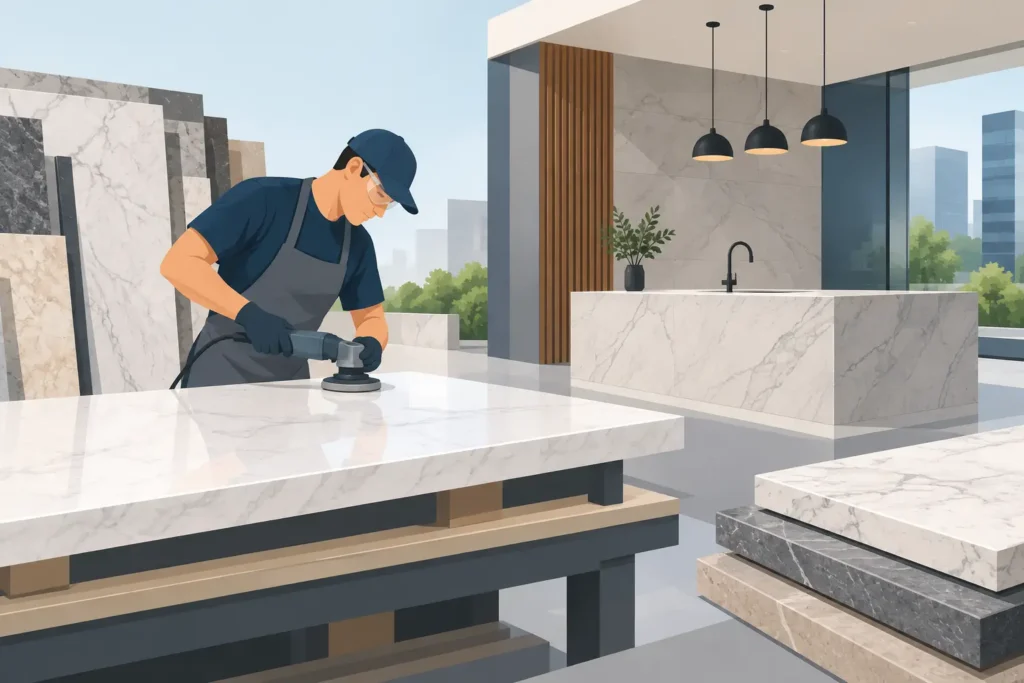
A busy lobby, leasing office, restaurant bar, or workplace reception desk has to do more than make a strong first impression. It must handle constant use, frequent cleaning, rolling luggage, moving furniture, and the occasional hard impact without losing its character. Commercial stone fabrication turns carefully selected slabs into surfaces that meet those real-world demands while giving a property a distinctive, finished look.
For builders, designers, property managers, and business owners, the difference is not simply the material. It is the planning behind it: choosing an appropriate stone, mapping the slab, engineering details around the application, and installing every piece with care. A beautiful slab can fall short if its seams, edges, supports, or transitions are not considered early.
What Commercial Stone Fabrication Includes
Commercial fabrication is the process of measuring, cutting, shaping, finishing, and preparing natural or engineered stone for a specific project. The work may involve reception counters, conference tables, restroom vanities, fireplace surrounds, stair treads, flooring, exterior cladding, window surrounds, columns, bar tops, and outdoor gathering areas.
Each application creates its own requirements. A countertop in a high-traffic break room needs a practical edge profile and dependable support around cutouts. Exterior pavers and pool-deck surfaces must be selected with weather exposure and slip resistance in mind. Wall cladding needs thoughtful layout, secure attachment, and consistent visual movement from piece to piece.
That is why commercial work should begin well before fabrication. Accurate field measurements, cabinet or framing verification, plumbing and electrical coordination, access planning, and material approval all protect the schedule and help prevent avoidable changes once the project is underway.
Start With the Use of the Space
The right material is not always the most dramatic one in the showroom. It is the one that fits the property’s daily use, maintenance expectations, budget, and design direction.
Quartz is often a practical choice for interior counters and work surfaces because it offers consistent color options and simple day-to-day care. Granite brings natural variation and reliable durability, making it well suited for many interior and exterior applications. Quartzite offers the movement and character of natural stone with strong performance, though each slab should be evaluated for its particular finish and application. Marble creates an unmistakable sense of luxury for feature walls, vanities, fireplaces, and reception areas, but it may develop a patina over time in heavily used spaces. Soapstone and limestone can be equally compelling when the design calls for a softer, more tailored appearance, provided their maintenance needs align with the project.
There is no universal winner. A hospitality bar with frequent food and beverage service has different priorities than a polished office reception desk. A multi-family amenity space may need repeatable selections and efficient replacement options, while a boutique retail project may place greater value on a one-of-a-kind slab layout.
Appearance Should Be Planned Slab by Slab
Natural stone is not a printed pattern. Veining, shading, mineral deposits, and movement vary across every slab. That variation is part of its appeal, but it also requires intentional planning.
During slab selection, the fabricator can help determine which areas of the material will become focal points, where seams should fall, and how adjoining pieces will relate. This is especially important for large reception counters, bookmatched feature panels, waterfall ends, fireplace surrounds, and long bar tops. A well-planned layout looks purposeful. A rushed layout can make even premium material feel disjointed.
Visiting a showroom and viewing full slabs also gives project teams a more reliable understanding of color and movement than small samples can provide. Lighting, nearby finishes, cabinetry, wall color, and metal accents should all be considered together whenever possible.
Details That Separate a Finished Project From an Average One
Fabrication quality becomes visible at the edges, joints, cutouts, and transitions. These are the areas that customers touch, maintenance teams clean, and occupants notice every day.
Edge profiles should complement the project rather than compete with it. A clean eased edge may suit a contemporary office or multi-family kitchen, while a more substantial profile can add presence to a hospitality counter or traditional lobby. The best choice also considers safety, cleaning, and how the surface meets adjacent millwork.
Seams deserve the same attention. In many larger installations, seams are necessary due to slab size, transportation, access, or the geometry of the space. The goal is not to promise that every seam will disappear. The goal is to place seams strategically, align the material as closely as possible, and create a clean, durable joint.
Cutouts for sinks, faucets, dispensers, electrical components, and other fixtures must be precisely located. Stone fabricators also need to account for overhangs, support requirements, wall conditions, and the weight of the finished pieces. A stone surface is only as dependable as the structure beneath it.
Installation Is a Coordination Job
Even the most carefully fabricated pieces need a controlled installation. Commercial sites may have restricted delivery windows, occupied suites, elevator limitations, finished flooring, security procedures, and other trades working nearby. Planning these details in advance helps the installation move efficiently and protects surrounding finishes.
A qualified team verifies field conditions before final fabrication whenever possible. Cabinets and supports should be level and secure, walls should be ready for scribing or attachment, and required fixtures should be available or clearly specified. For larger work, delivery routes and staging areas matter just as much as measurements.
Fast installation is valuable, but it should never mean skipping preparation. Good coordination reduces disruption for tenants, staff, customers, and other contractors while helping the final work look clean from every angle.
Think Beyond the Countertop
Commercial stone can establish continuity across a property. The same material family may appear at a reception desk, in restroom vanities, around a fireplace, along a feature wall, or in an outdoor entry area. Used thoughtfully, those repeated elements make a building feel more considered without making every space look identical.
This broader approach can be particularly effective in multi-family properties. Leasing offices, clubrooms, package areas, shared kitchens, mail rooms, corridors, and outdoor amenities all contribute to a resident’s experience. Durable stone details can support a higher-end impression while standing up to the demands of shared spaces.
Exterior projects require additional judgment. Sun exposure, water management, temperature changes, surface texture, and the specific installation method all influence material selection. A finish that looks ideal indoors may not be appropriate for an exposed patio or entry. Discussing the full application early allows the design team and fabricator to recommend options with performance in mind.
A Better Process for Commercial Stone Fabrication
The strongest projects follow a clear sequence: review the intended use, select materials, confirm the design details, measure after supporting structures are ready, fabricate from approved plans, and install with site conditions in mind. That process may sound straightforward, but it is where experience pays off.
At Marble Unlimited, commercial clients can work with a team that understands both the visual and practical sides of stone. With full slabs available for viewing and fabrication and installation handled as part of the project, decisions can be made with the complete finished space in view.
Before requesting a quote, gather drawings, approximate dimensions, finish selections, and a realistic project timeline. If the material has not been selected, bring inspiration images and information about how the area will be used. Those details help shape recommendations that are attractive, serviceable, and appropriate for the investment.
The right commercial stone surface should feel intentional long after opening day. Schedule a showroom visit or request a free quote to start the conversation with the application, the people using the space, and the level of craftsmanship the project deserves.