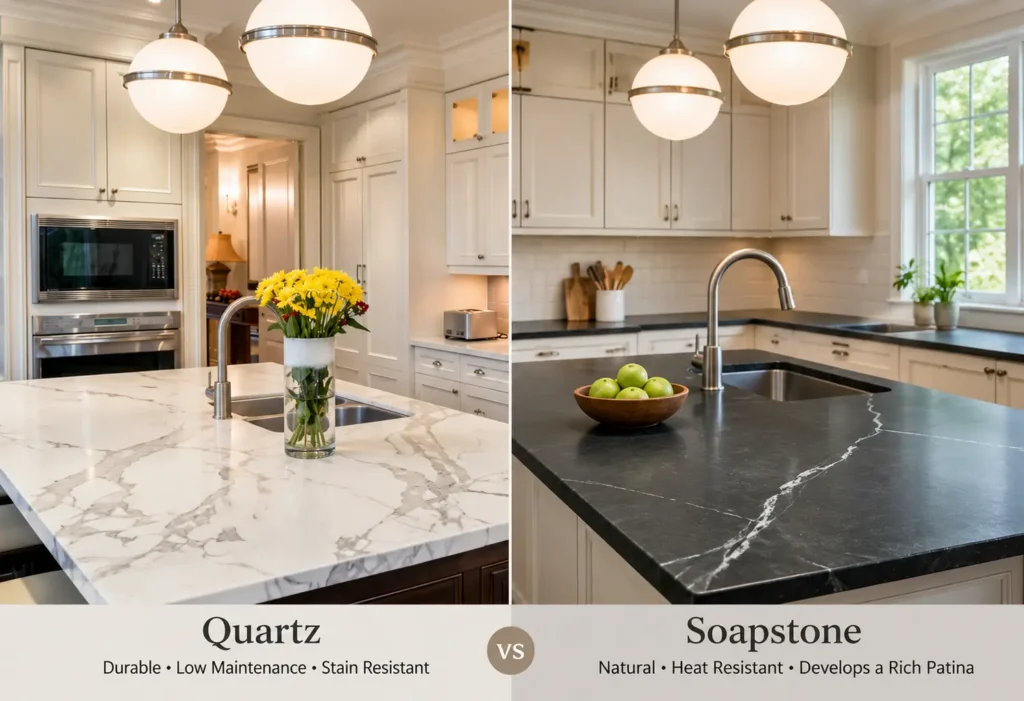
A dark, softly honed soapstone island can make a kitchen feel collected and architectural. A bright quartz surface can create a crisp, tailored look with very little daily upkeep. In the soapstone vs quartz decision, there is no universal winner. The better choice depends on how you cook, how you want the room to age, and whether natural variation or predictable color matters most to your design.
For homeowners planning a kitchen or bath renovation, the most useful comparison goes beyond a sample in a showroom. It comes down to performance in real life: hot cookware, busy mornings, family meals, sunlight, cleaning habits, and the character you want your home to carry for years.
Soapstone vs Quartz at a Glance
Soapstone is a natural stone, typically a dense material with a smooth feel and a matte to softly polished finish. It is known for deep charcoal, gray, green-gray, and blue-gray tones, often with subtle veining. Every slab has its own movement, mineral pattern, and color variation.
Quartz countertops are engineered surfaces made from natural quartz minerals combined with resins and pigments. They are available in an extensive range of colors and patterns, from clean whites and warm neutrals to designs that resemble natural stone. Because quartz is manufactured, it generally offers more consistency from one area of the slab to another.
That distinction influences the entire selection process. Soapstone appeals to homeowners who want an authentic material that develops personality over time. Quartz is often the practical favorite for homeowners who want a controlled look and straightforward maintenance.
Appearance: Character Versus Consistency
Soapstone has an unmistakable presence. Its finish absorbs light rather than reflecting it sharply, which gives it a calm, substantial appearance. In a traditional kitchen, it can feel classic and established. In a modern kitchen with light cabinetry and clean lines, it provides contrast without looking overly formal.
The surface will not remain perfectly unchanged. Soapstone may darken unevenly at first, especially if mineral oil or a darkening treatment is used. Small scratches and marks can become part of its lived-in look. Some homeowners love that evolving patina; others prefer a countertop that looks nearly identical on day one and year ten.
Quartz gives you more control. If your project calls for a bright white surface, a specific gray vein pattern, or a uniform neutral that coordinates closely with cabinetry and wall finishes, quartz can make design decisions easier. It is particularly useful when continuity across a large kitchen, multiple bathrooms, or a multi-unit project matters.
Neither look is inherently more luxurious. A well-selected slab of soapstone can feel deeply custom, while a thoughtfully chosen quartz can look refined and intentional. The key is choosing the material that supports the rest of the room rather than competing with it.
Daily Care and Stain Resistance
Quartz is one of the lowest-maintenance countertop options available. For most households, warm water, mild soap, and a soft cloth are enough for regular cleaning. The resin-bound surface is nonporous, so it does not require periodic sealing and is highly resistant to common kitchen stains.
Soapstone is also nonporous and does not need sealing. That is an important advantage over many other natural stones. It resists staining well, and its dense composition makes it a comfortable choice for kitchens where spills happen often. Routine cleaning is simple, usually requiring mild soap and water.
The difference is aesthetic rather than sanitary. Soapstone can show fingerprints, water spots, or temporary darkening from oils, particularly when it has not yet developed an even patina. Mineral oil can help deepen the color and reduce the appearance of light marks, but it is optional. Some homeowners apply it regularly during the first year, while others allow the surface to age naturally.
If your priority is a countertop that asks very little of you visually, quartz has the advantage. If you are comfortable with a surface that gains character through use, soapstone remains remarkably easy to care for.
Heat, Scratches, and Real Kitchen Use
Soapstone performs exceptionally well around heat. Its natural composition makes it highly heat resistant, so it is a strong choice for avid cooks who routinely work with hot pans and baking dishes. It has long been used for fireplace surrounds and hearth applications for good reason.
Quartz is durable, but it is less forgiving of direct high heat. The resins in quartz can be damaged by extreme temperature changes, so a trivet is the right habit for hot cookware. This is not a major inconvenience for most kitchens, but it matters for homeowners who expect to place cookware directly from the range or oven onto the counter.
On the other hand, quartz is generally more resistant to everyday scratching than soapstone. Soapstone is relatively soft compared with quartz and can pick up scratches from knives, heavy cookware, or rough use. The good news is that minor scratches can often be softened with fine sanding or allowed to blend into the patina. A scratch on quartz is less likely, but repairing a deep chip or damage can be more involved.
For an active family kitchen, think honestly about your household. If you want the greatest resistance to routine scuffs and marks, quartz is often the easier fit. If heat performance and a forgiving, repairable natural surface are more important, soapstone deserves serious consideration.
Cost and Installation Considerations
Pricing for soapstone and quartz varies widely by color, thickness, slab availability, layout complexity, edge detail, cutouts, and installation conditions. It is more useful to compare complete project estimates than to rely on a single per-square-foot figure.
Some quartz designs are priced competitively, while premium patterns with dramatic movement can move into a higher range. Soapstone pricing also depends on the grade, origin, slab size, and visual characteristics. A compact kitchen with a simple layout may make either material attainable, while a large island, full-height backsplash, or multiple fabricated pieces will naturally increase the project scope.
Fabrication quality matters as much as material selection. Proper templating, seam placement, support planning, sink cutouts, and edge finishing all affect how a countertop looks and performs after installation. Natural soapstone often has distinctive veining that should be considered during layout, while quartz patterns may need careful alignment at seams to preserve a continuous appearance.
An in-person slab viewing is especially valuable for soapstone. A small sample cannot show the full range of movement, veining, or depth that will appear across an island. For quartz, viewing a larger sample or full slab also helps confirm that the pattern and background tone work with your cabinetry under real lighting.
Where Each Material Works Best
Soapstone is especially at home in kitchens with warmth, texture, and a sense of permanence. It pairs beautifully with painted cabinetry, natural wood, brass or aged metal hardware, and simple architectural details. Its heat resistance also makes it a compelling option near cooking zones and fireplace applications.
Quartz works well in kitchens and bathrooms where consistent color, light-reflective brightness, and minimal maintenance lead the decision. It can support a clean contemporary design, a transitional renovation, or a classic space that needs a quiet backdrop for more expressive cabinetry and hardware. Its nonporous surface is also reassuring for busy bathroom vanities.
There are situations where mixing materials is the smartest design decision. A homeowner may choose quartz for the main work surfaces and use soapstone for an island or bar area that calls for more visual depth. This approach can balance practical needs with a more individual look.
How to Make the Right Choice for Your Home
Start with the part of your routine that matters most. Choose quartz if you want color consistency, a highly scratch-resistant surface, and minimal ongoing attention. Choose soapstone if you value natural variation, excellent heat resistance, and a finish that becomes more personal with age.
Then consider the room as a whole. Bring cabinet door samples, paint colors, hardware selections, and photos of adjoining spaces to your material appointment. The right countertop is not selected in isolation. It should work with your lighting, floor tone, sink style, and the way your family uses the room.
At Marble Unlimited, our team can help you compare full slabs, review edge and sink options, and understand how each material will perform in your specific project. A showroom visit gives you the chance to see soapstone’s depth and quartz’s range of patterns in person, rather than making a lasting decision from a small sample.
The best countertop is the one you will enjoy using every day. Let the material’s real behavior, not just its first impression, guide your choice.