
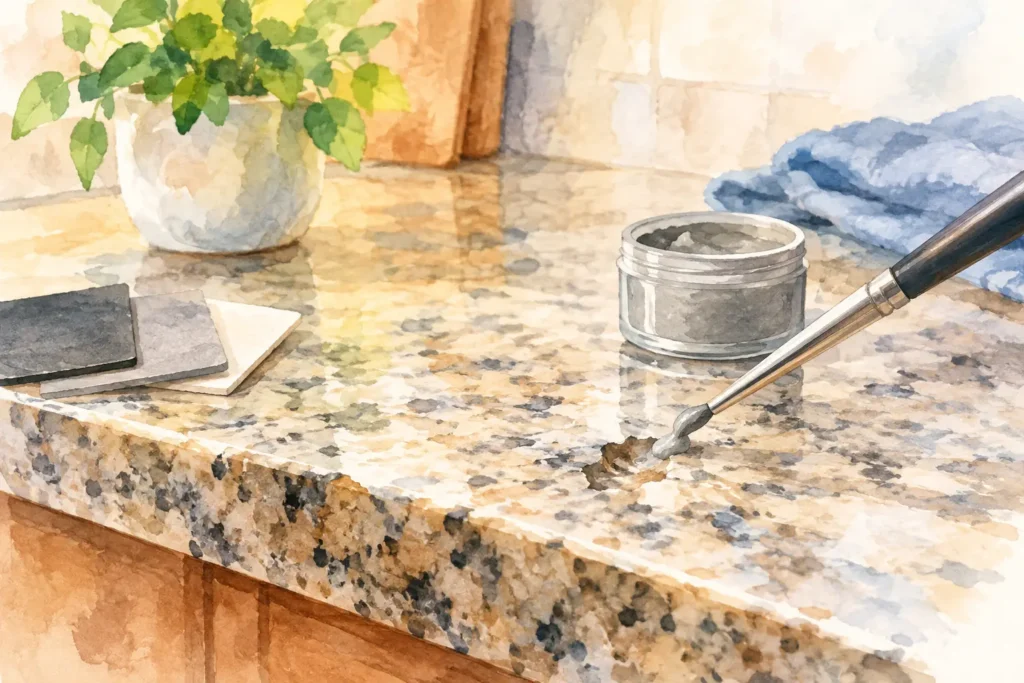
A small chip on a granite countertop has a way of becoming the first thing you see when you walk into the kitchen. The good news is that can granite chips be repaired is usually not a question of whether repair is possible, but whether the repair will be durable and visually discreet enough for the chip’s location, size, and the granite’s color and pattern.
Granite is exceptionally hard, which is one reason it remains a favorite for kitchens, bathrooms, fireplaces, and outdoor living spaces. It is not indestructible, however. A dropped pan, a sharp impact along an overhang, or stress around a sink cutout can leave a small nick or chip. With the right materials and skilled color matching, many of these imperfections can be restored without replacing the countertop.
Can Granite Chips Be Repaired Without Replacing the Countertop?
In most cases, yes. Professional stone repair uses a clear or color-tinted resin designed to bond with natural stone. The technician cleans and prepares the damaged area, builds the missing section with resin, then shapes, levels, and polishes it to match the surrounding finish as closely as possible.
A successful repair should feel smooth to the touch and be far less noticeable from normal standing distance. That does not always mean it will disappear completely. Granite is a natural material with mineral movement, flecks, veins, and variation that cannot be copied perfectly. On a busy, multicolor granite, a small repair may be very difficult to find. On a solid black, white, or highly polished surface, even a well-executed repair can remain faintly visible in certain lighting.
The goal is not to make an unrealistic promise. It is to stabilize the stone, restore the edge or surface profile, and make the repair blend naturally into a countertop that still looks and performs beautifully.
What Makes a Granite Chip Repair More or Less Noticeable?
The location of the chip matters as much as its size. A small nick along a countertop edge is often straightforward to fill and reshape. A chip in the middle of a large, highly visible section can require more careful color work and polishing. Damage near a seam, sink opening, cooktop cutout, or unsupported overhang deserves a closer inspection because those areas can be subject to additional stress.
Granite color also affects expectations. Speckled tan, brown, gray, gold, and richly patterned slabs tend to be forgiving because their natural variation helps conceal a repair. Very light granite can make dark resin stand out, while very dark granite may show a dull spot if the repaired area is not polished to the same sheen as the rest of the surface.
Depth is another factor. A shallow surface chip may need only a small amount of resin. A deeper break at an exposed edge can still often be repaired, but it must be rebuilt carefully to preserve a clean line and avoid a weak spot. If a piece has broken away and you still have it, save it. In some situations, reattaching the original fragment can produce the most natural result.
When a Chip Signals a Bigger Stone Problem
A single impact chip is commonly a cosmetic issue. A chip paired with a crack, shifting seam, loose countertop section, or damage around a sink is different. Filling the visible opening without addressing the underlying cause can leave the countertop vulnerable to further damage.
Pay close attention if you notice a crack running from the chip, a repaired area that continues to widen, or movement when pressure is applied nearby. These signs may point to inadequate support, stress from an appliance opening, settling cabinetry, or a previous installation issue. A qualified fabricator can determine whether the stone needs reinforcement from below, seam work, or a more involved repair.
This is particularly relevant around undermount sinks. Water exposure, heavy cookware, and the weight of a full sink can put strain on the stone if support is compromised. A professional assessment protects both the countertop and the cabinetry beneath it.
What a Professional Granite Repair Involves
Quality repair is detail-oriented work, not simply applying filler over a damaged spot. The process begins with removing residue, loose material, and oils that can interfere with adhesion. The damaged area is then prepared so the resin can bond securely.
A stone professional selects or creates a resin color that works with the slab’s background tone and mineral pattern. Depending on the granite, this may involve blending pigments rather than using one flat color. The resin is applied in controlled layers, cured, and shaped to restore the plane of the countertop or profile of the edge.
The final polishing stage is where craftsmanship becomes especially visible. Granite may have a polished, honed, leathered, or other finish, and the repaired area needs to be refined accordingly. An edge repair also has to follow the existing profile so it does not feel sharp, flat, or uneven when you run a hand along it.
For homeowners considering a do-it-yourself kit, the trade-off is simple: small, hidden chips may be reasonable candidates for a careful temporary touch-up, but color matching and finish restoration are difficult to achieve without stone-specific experience. A repair that cures too high, turns cloudy, traps dirt, or leaves a mismatched gloss can draw more attention than the original chip.
How to Protect Granite After a Repair
Once a repair is complete, normal countertop care goes a long way. Use cutting boards rather than cutting directly on the stone, and avoid striking exposed edges with heavy cookware. Granite is hard enough to resist everyday use, but the edges are naturally more vulnerable than the broad field of the slab.
Clean with a soft cloth, warm water, and a stone-safe cleaner when needed. Avoid harsh abrasives and strong chemical products that can dull the finish or affect the protective sealer over time. Promptly wipe up oils, wine, coffee, citrus, and other spills, especially if your granite has a lighter color or more open natural structure.
Sealing does not prevent impact damage, but it helps limit absorption and makes daily maintenance easier. The right sealing schedule depends on the particular granite and how the space is used. A fabricator can offer material-specific guidance rather than recommending a one-size-fits-all routine.
When Replacement Is the Better Choice
Replacement is rarely necessary for one small chip. It becomes worth considering when the granite has extensive cracking, repeated failures around a seam or cutout, major structural damage, or a repair area so large that it cannot be blended satisfactorily. It may also make sense when a homeowner is already planning new cabinetry, a different sink configuration, or a broader kitchen renovation.
Before deciding, ask for a professional evaluation. The best solution may be a precise repair, reinforcement and repair, or a replacement section depending on how the countertop was fabricated and installed. Seeing the slab in person is essential because photographs do not always reveal depth, finish, or structural concerns.
For homeowners in the Triangle considering a repair or a larger countertop update, Marble Unlimited can help evaluate the condition of existing stone and discuss material options that suit the way your household lives. A small chip should not take away from a kitchen you love. With knowledgeable assessment and careful craftsmanship, it can often become a minor detail rather than a reason to start over.