
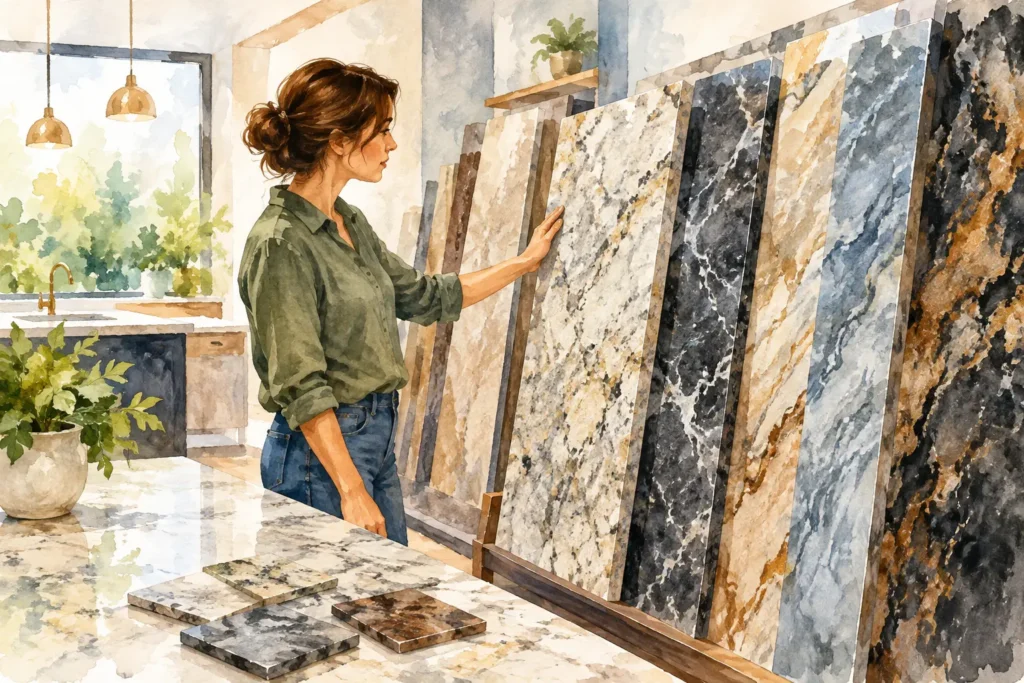
A granite sample can tell you whether you like a general color family. It cannot tell you how the finished kitchen island will look. Granite is a natural material with real variation from one area of a slab to the next, which is why knowing how to select granite slabs means looking beyond a small showroom piece. The right slab should work with your cabinetry, lighting, layout, and daily routine – not simply look good under showroom lights.
For homeowners planning a kitchen, bath, fireplace surround, or outdoor surface, slab selection is one of the most satisfying parts of the project. It is also the point where a little professional guidance can prevent costly surprises. A careful selection process lets you appreciate the material’s character while making confident decisions about seams, edges, sink placement, and fabrication.
Start With the Whole Room, Not the Stone Alone
Before walking the slab gallery, bring the elements that are staying in the room. A cabinet door, paint swatch, backsplash sample, flooring sample, and a few photographs of the space give your designer useful context. If you are choosing finishes at the same time, narrow down the cabinet color and overall direction first. Granite can vary dramatically in warmth, pattern, and contrast, so it is easier to select when the room has a clear visual foundation.
Consider the visual role you want the countertop to play. A softly patterned granite can support statement cabinetry or a dramatic wall color. A slab with bold veining, high contrast, or crystalline movement may become the focal point of an otherwise restrained kitchen. Neither direction is automatically better. The decision depends on the scale of the room, the amount of natural light, and how many other patterns are already present.
Lighting deserves special attention. Granite can read warmer near incandescent lighting, cooler in bright daylight, and more reflective under under-cabinet fixtures. If possible, view your leading choices in more than one type of light. A knowledgeable showroom team can also help you identify colors that will remain comfortable with the light conditions in your home.
How to Select Granite Slabs by Color and Movement
Granite is valued precisely because it is not uniform. Mineral deposits create flecks, flowing veins, subtle clouds, and occasional areas of concentrated pattern. When you view a full slab, stand back several feet first. This is the distance from which you will experience the countertop as part of the room. Then move closer to examine the detail, texture, and variation.
A slab’s background color is only one part of the decision. Look for secondary colors that may connect to your cabinets, hardware, wall color, or flooring. A gray granite, for example, may carry blue, taupe, charcoal, or brown undertones that become more visible once it is installed. Warm white cabinetry can make those undertones appear different than cool white cabinetry.
Movement refers to the direction and intensity of the pattern. Some slabs have an even, granular appearance that feels calm across a large countertop. Others have sweeping lines or dramatic changes in color. Strong movement can be striking on an island, but it requires more planning because cuts, seams, and openings will affect how that movement appears.
Ask to see the actual slabs reserved for your project, rather than selecting solely by a named sample. Even slabs from the same material grouping may vary. If your project needs more than one slab, view them together and confirm they are a suitable match in tone and pattern.
Inspect the Slab With a Fabricator’s Eye
Natural characteristics are not the same as defects. Small mineral pits, fissures, color changes, and crystalline areas may be part of granite’s authentic appearance. Many homeowners come to appreciate these details because they confirm the material is unique. Still, you should understand where those features are located and whether they will fall in a prominent area.
During slab selection, inspect the surface from several angles. Look for areas with pronounced fissures, changes in polish, or visible texture. Ask which characteristics are natural and what can be expected after fabrication. An experienced fabricator can explain whether a feature is cosmetic, how it will be treated, and whether it is best positioned near a less noticeable edge or cutout.
Also examine the slab’s finish. A polished finish reflects light and often enhances depth and color, making it a popular choice for kitchens and bathrooms. A honed finish has a softer, lower-sheen appearance that can feel more relaxed and contemporary. The best choice depends on the look you want and your expectations for day-to-day care. Honed surfaces may show fingerprints or moisture differently than polished granite, particularly in darker colors.
Plan the Layout Before You Fall in Love With One Area
The most beautiful section of a slab may not end up centered on the island. Every countertop requires cuts for dimensions, corners, seams, sink openings, cooktops, and edge details. Planning the layout early helps ensure that the stone’s most attractive movement appears where it will have the greatest impact.
For a large island, ask to review the slab layout before fabrication begins. This is especially worthwhile when the granite has broad veining, a directional pattern, or a dramatic color transition. You can discuss which end of the slab should face the room, whether the pattern should run lengthwise or across the island, and how the perimeter pieces will relate to it.
Seams are sometimes necessary because of slab size, room access, cabinet configuration, or the safe handling of heavy stone. Good seam placement is both a design and installation decision. In many kitchens, seams can be placed away from the most visible areas or aligned thoughtfully with a change in cabinet layout. They will not disappear entirely, but skilled fabrication and installation make them as discreet as practical.
Do not overlook sink and cooktop placement. A busy section of granite can draw attention away from the clean lines of an undermount sink, while a quieter area may frame it more elegantly. Your fabricator can balance the visual layout with the structural requirements around cutouts.
Match the Granite to How You Live
Granite is a durable choice for active households, but the ideal slab still depends on your habits. A family that cooks frequently may prefer a pattern that is forgiving of crumbs and everyday water spots. Someone designing a showpiece kitchen may be willing to choose a lighter or more dramatic granite because the visual reward matters most.
Ask practical questions before making the final selection. How will the color handle the room’s lighting? Will the pattern feel busy once paired with the cabinetry? Does the finish suit your comfort level with routine cleaning and resealing? Granite is generally straightforward to maintain when properly sealed, but no natural stone should be treated as completely maintenance-free.
The edge profile also changes the finished look. A simple eased edge keeps attention on the slab and suits many styles. More detailed profiles can add traditional character, though they may be better suited to a room with enough visual space to support them. Reviewing edge samples beside the selected granite makes the decision much easier.
Use the Showroom Visit to Make Better Decisions
A slab showroom gives you the advantage of comparison. Rather than trying to imagine a material from a photograph, you can see scale, movement, finish, and color in person. Take your time with the leading options. Photograph them beside your samples, but trust your in-person impression over a phone screen, which can shift color and exaggerate contrast.
At Marble Unlimited, homeowners can review full slabs with experienced guidance before custom fabrication and installation. That conversation should include more than color preference. It should cover your measurements, design priorities, intended edge, sink choice, likely seam locations, and the practical needs of the room.
When a particular slab keeps drawing you back, pause long enough to check that it works from every angle. Look at the full slab, not just the most photogenic corner. Confirm the available quantity, review the proposed layout, and ask every question you have before the material moves into fabrication.
The goal is not to find a slab with no variation. It is to choose one whose variation feels intentional in your home, then work with craftsmen who know how to place, cut, and install it with care. Schedule a showroom visit when you are ready to see the difference a full granite slab can make.